
The Bubastite Portal or the Bubastite gate refers to the monumental southern gateway of the Precinct of Amun-Re temple complex, situated east of the temple of Ramesses III and the second pylon. It bears the principal surviving inscription of the Libyan Twenty-second Dynasty, most notably the triumphal reliefs of Pharaoh Sheshonq I (circa 945–924 BCE), identified with the biblical Shishaq. The possible significance of the Bubastite Portal was not apparent prior to the decipherment of hieroglyphics. Jean-François Champollion visited Karnak in 1828, six years after his publication of the Rosetta Stone translation.
The Bubastite Portal occupies a liminal position at the southern end of the Great Hypostyle Hall, forming a transitional passage between earlier New Kingdom constructions and later Libyan-period additions. Although structurally integrated into the Karnak complex, its historical significance derives primarily from the political ideology and territorial ambitions articulated in its reliefs. Commissioned during the reign of Sheshonq I, founder of the Twenty-second Dynasty of ancient Egypt, (also known as the "Bubastite Dynasty") and former Great Chief of the Ma, the portal’s decoration commemorates his military incursion into the southern Levant. These scenes constitute the only substantial royal inscription surviving from his rule and provide an indispensable primary source for the geopolitical dynamics of the early Iron Age in the eastern Mediterranean.

circa 1180 BCE

The Bubastite Portal is the south entrance to the great First Court of the Temple of Amun at Karnak. It was architecturally conceived as a uniform part of the wall and colonnade surrounding the court. Had it not been for the presence of the temple of Ramsses III in the way, this entrance would probably have been placed directly opposite the north entrance at a point almost exactly in the middle of the Ramsses temple. Under the circumstances it was built to occupy the space between the Second Pylon and the Ramses temple, and became somewhat more elaborate than the north entrance by the necessary addition of a pilaster against each of the earlier structures.
Architecturally, the Bubastite Portal follows the canonical form of a monumental stone gateway in sandstone, with a wide central passage flanked by jambs, surmounted by an oversized lintel on the south and two monumental columns on the north. The decoration is executed in sunk relief, consistent with the practices of the Third Intermediate Period. The southern façade is the principal inscribed surface and is organized into vertical registers that divide the narrative and topographical elements. Flanking the central doorway are large-scale depictions of Sheshonq I in the conventional pose of a victorious pharaoh grasping bound captives. The spatial logic of the composition draws on New Kingdom prototypes but reveals the stylistic tendencies of Libyan rule, including more rigid figural outlines and a somewhat compressed hieroglyphic layout, particularly in the topographical lists.
circa 1180 BCE
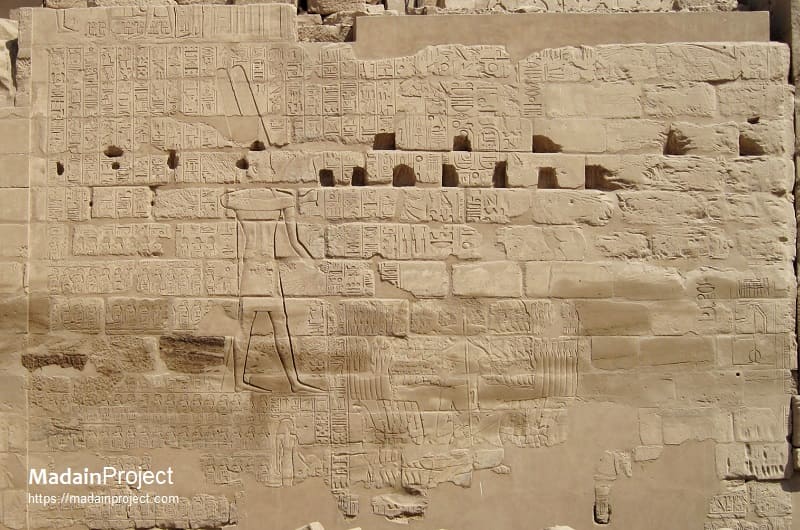
The most significant component of the portal’s decoration is the long list of toponyms representing cities, regions, or fortified sites associated with Sheshonq I’s campaign. Each place name is enclosed in an oval cartouche-like frame surmounted by a bound Asiatic figure, a convention derived from the “name-ring” lists of the Eighteenth and Nineteenth Dynasties. The list groups the sites geographically, allowing partial reconstruction of the route of the Egyptian army through the northern Negev, the Shephelah, and the hill country of Palestine. While many of the names correspond to well-attested towns, others remain debated due to orthographic irregularities or ambiguous phonetic renderings in Egyptian.
The accompanying narrative scenes, though limited in textual detail, affirm the pharaoh’s role as restorer of order and protector of the divine cult. A dedicatory inscription on the northern jamb identifies the portal as a pious offering to Amun-Re, linking the military campaign to the maintenance of cosmic balance and temple prosperity. The juxtaposition of triumphal iconography with ritual text exemplifies the characteristic fusion of political and religious ideology in Third Intermediate Period monuments.
circa 1180 BCE

The Bubastite Portal has long been associated with the account in 1 Kings 14:25–28 and 2 Chronicles 12:2–9 describing the campaign of “Shishak king of Egypt” against the kingdom of Judah in the fifth year of Rehoboam. Scholarly consensus identifies Sheshonq I as the historical prototype for “Shishak”, based on phonetic correspondences, chronological alignment, and the lack of any other plausible Egyptian candidate. Although Jerusalem itself does not appear among the inscribed place names, the presence of numerous towns in the northern and central hill country suggests a campaign that affected both the northern kingdom of Israel and the southern kingdom of Judah. The omission of Jerusalem may reflect ideological selectivity, differences in Egyptian record-keeping conventions, or the possibility of negotiated submission rather than direct conquest.
The Bubastite Portal thus stands at the intersection of Egyptian royal propaganda and the historiographic traditions of the Hebrew Bible. Its inscriptions supply external corroboration for Egyptian military activity in the Levant during the early divided monarchy and provide one of the most tangible synchronisms linking the archaeological, epigraphic, and biblical records of the tenth century BCE.


Signup for our monthly newsletter / online magazine.
No spam, we promise.

The Madain Project is an online archive of Abrahamic History and Archaeology.
Abrahamic History & Archaeology is the study of history and archaeology with respect to the three Abrahamic Faiths without considering the religious and theological aspects. The goal of Abrahamic History is to understand how and why the religious doctrines and behaviours have evlovled and changed over time. Searching for patterns in the evolution of significant cultural events such as the development of farming, the emergence of cities, or the collapse of major civilizations for clues of why and how these have influenced the three major Abrahamic religions.
Cloud Drive -
About -
Help -
Privacy Policy -
Contact
Madain Project: Encyclopedia of Abrahamic History & Archaeology.
Copyright MadainProject 2017 - 2026.


