
Ancient Epidaurus, located in the northeastern Peloponnese of ancient Greece, was a prominent city (polis) of antiquity renowned for its religious and cultural significance. Dedicated to Asclepius, the god of medicine, Epidaurus was home to one of the most famous healing sanctuaries in the ancient world, drawing pilgrims seeking cures for their ailments. Its centerpiece was the Sanctuary of Asclepius, a sprawling complex that included temples, a tholos, and healing facilities. Epidaurus is also celebrated for its stunning open-air theater, an architectural marvel of the fourth century BCE, famed for its exceptional acoustics and harmonious design, which still hosts performances today. This ancient city seamlessly blends spiritual heritage with artistic achievement, offering a window into the healing practices and cultural life of classical Greece.
During antiquity the city of Epidaurus was an important local center in the Argolid, on account of the tracts of tertile land in its environs and, primarily, of its harbour on the Saronic Gulf, which facilitated swift communication with ancient cities of Corinth, Athens, and the Aegean in general. Indications of habitation on the site of the later city date back to the third millennium BCE. Chamber tombs on the hillocks overlooking the harbour bear witness to a significant heyday during the Mycenaean period (circa second millennium BCE). In historical times Epidaurus was a Dorian city. However, its population originated mainly from subject pre-Dorian tribes and vacillated between guarded relations or conflicts with the powerful Dorian center of nearby Argos and relations of affinity with Ionian Athens and commercial Corinth.
Epidaurus transcended its local importance thanks to its sacred center of healing, an Asklepieion, which was considered the cradle of the art of medicine and mother sanctuary of the 200 or so Asklepieia dispersed throughout the ancient world, from the east as far as Rome.
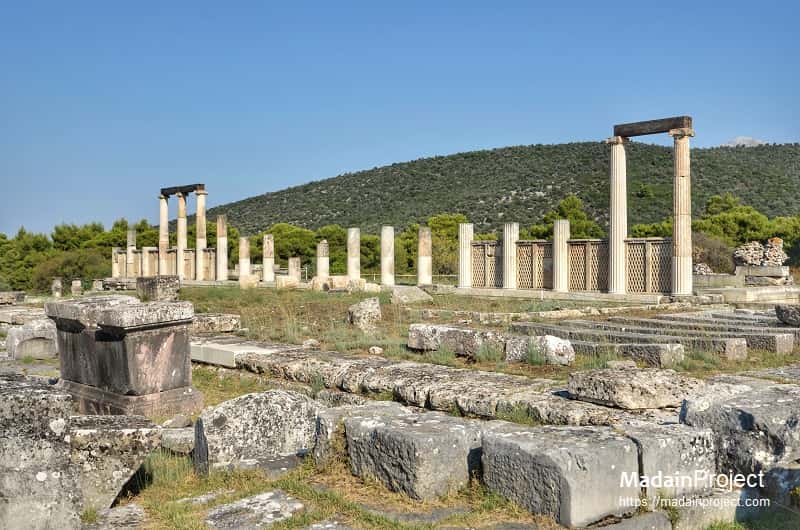
circa 380 BCE

Ancient Epidaurus emerged as a significant religious and civic center during the Late Helladic period (circa 1500 BCE), with evidence of early settlements and cult activity on the lower terraces of the acropolis and surrounding plains. By the 6th century BCE, the city had begun to organize itself politically and religiously, establishing itself as a regional cult center with dedications to local deities. Inscriptions from the fifth century BCE reveal its participation in amphictyonic councils and pan-Hellenic alliances, highlighting its integration into the broader political and religious networks of the classical Greek world. These early centuries also saw the development of urban infrastructure and the first iterations of sanctuary precincts that would later form the nucleus of the Asklepieion.
The fourth century BCE marked the establishment of the sanctuary of Asclepius, which would define the historical and cultural identity of Epidaurus. The sanctuary was arranged over multiple terraces, incorporating a Doric temple dedicated to Asclepius, the abaton where patients slept to receive healing visions, altars, stoae, and baths. During this period, the sanctuary became closely associated with emerging medical practices and Hippocratic theories of healing, attracting pilgrims and patients seeking divine and therapeutic intervention. The integration of cult, medicine, and civic display established Epidaurus as a model for other healing centers across the Greek world.
Hellenistic Epidaurus witnessed both expansion and architectural refinement. The theatre, constructed in the late fourth century BCE, exemplified advanced Greek engineering and acoustics, accommodating approximately 14,000 spectators and serving as a center for civic, religious, and cultural gatherings. Additional Hellenistic improvements included extended stoae, expanded altars, and the creation of treasuries, reflecting the increasing wealth and prestige of the city. Inscriptions from this period document civic decrees, dedications, and regulations for medical practice, illustrating a highly organized urban society that combined religious devotion, healing, and public life in a cohesive manner.
During the Roman period (circa around the mid-2nd century BCE until 426 CE), Epidaurus retained its religious and civic significance, receiving imperial patronage that supported the enlargement of the theatre, the construction of a palaestra and gymnasium complex, and improvements to the sanctuary infrastructure. Prominent Romans are known to have visited or funded the site, ensuring its status as a pan-Hellenic pilgrimage destination. Despite a gradual decline during Late Antiquity, the city maintained a continuity of ritual and civic functions, leaving behind a detailed archaeological and epigraphic record that preserves its legacy as one of the most important centers of healing, religious practice, and cultural life in ancient Greece.
circa 380 BCE

The archaeological site of ancient Epidaurus constitutes a stratified sanctuary complex whose material record documents continuous architectural and cultic development from the Archaic through the Roman periods. Archaeological evidence demonstrates a coherent spatial hierarchy, with monuments arranged to accommodate ritual circulation, communal gatherings, and specialized functions within a carefully defined sacred landscape. Principal structures—including the Temple of Asclepius, the tholos, abaton, stoas, stadium, and the exceptionally well-preserved theater attributed to Polykleitos the Younger—are constructed primarily of local limestone and exhibit successive building phases that reflect evolving architectural techniques and sociopolitical conditions.
The theater, in particular, exemplifies Classical Greek principles of harmony, proportion, and acoustical refinement. Inscriptions, votive deposits, and architectural remains provide insight into administrative organization, cult regulation, and patterns of patronage, while the presence of ancillary and hospital-related facilities attests to the large-scale management of visitors. Collectively, the remains of Epidaurus offer a comprehensive case study for sanctuary planning, monumentality, and long-term site use, contributing significantly to the understanding of ancient Greek architecture, religious practice, and medical culture.


Signup for our monthly newsletter / online magazine.
No spam, we promise.

The Madain Project is an online archive of Abrahamic History and Archaeology.
Abrahamic History & Archaeology is the study of history and archaeology with respect to the three Abrahamic Faiths without considering the religious and theological aspects. The goal of Abrahamic History is to understand how and why the religious doctrines and behaviours have evlovled and changed over time. Searching for patterns in the evolution of significant cultural events such as the development of farming, the emergence of cities, or the collapse of major civilizations for clues of why and how these have influenced the three major Abrahamic religions.
Cloud Drive -
About -
Help -
Editorial Policy -
AI Policy -
Privacy Policy -
Contact
Madain Project: Encyclopedia of Abrahamic History & Archaeology.
Copyright MadainProject 2017 - 2026.


