
The Gates of Babylon were monumental entryways that punctuated the defensive walls of the ancient city of Babylon, one of the most prominent urban centers of Mesopotamia. Constructed primarily during the Neo-Babylonian Empire period (circa 605–562 BCE), these gates served both military and ceremonial functions, marking controlled access points into the city while demonstrating the wealth, religious devotion, and political authority of Babylonian rulers. Each gate was typically associated with a specific deity, reflecting the integration of urban infrastructure with religious and symbolic significance.
The primary architectural development of the gate system occurred during the Neo-Babylonian Empire, most notably during the expansive building campaigns of King Nebuchadnezzar II, who reigned from 605 BCE to 562 BCE. During this period, Babylon was heavily fortified with massive double-wall systems (Imgur-Enlil (the inner wall) and the Nimit-Enlil (the outer wall)) constructed primarily of sun-dried and baked mudbricks, owing to the scarcity of natural stone in the southern Mesopotamian alluvial plain.
Babylon’s gates were strategically located along the city’s fortified walls, which were among the most extensive in the ancient world, stretching over 15 kilometers. The gates were not uniform in design; while all were constructed with mudbrick and faced with glazed bricks in vibrant colors, their size, decorative motifs, and the deities they honored varied according to their ceremonial or defensive function. Many gates were richly adorned with bas-reliefs of lions, dragons, and other symbolic creatures, illustrating the power of Babylonian kings and the protective authority of the gods. Beyond their practical function of regulating entry, the gates formed key points for processions, religious observances, and display of royal propaganda.
Babylon’s gates were distinguished by monumental scale, ceremonial symbolism, and artistic sophistication. Constructed primarily from mudbrick, they were faced with glazed bricks in blue, yellow, and brown hues, often depicting animals and mythological creatures. The gates incorporated arched openings, defensive towers, and inscriptions in cuneiform, recording dedications to gods or the achievements of kings. Beyond practical function, the gates were carefully designed to convey the city’s political and religious hierarchy, demonstrating the interconnection of urban planning, defense, and ritual performance in Neo-Babylonian society.
In the Neo-Babylonian period, particularly during the 6th century BCE under rulers such as Nebuchadnezzar II (reigned 605–562 BCE), Babylon’s city walls are known from inscriptions to have included multiple gates named after deities or cultic concepts.
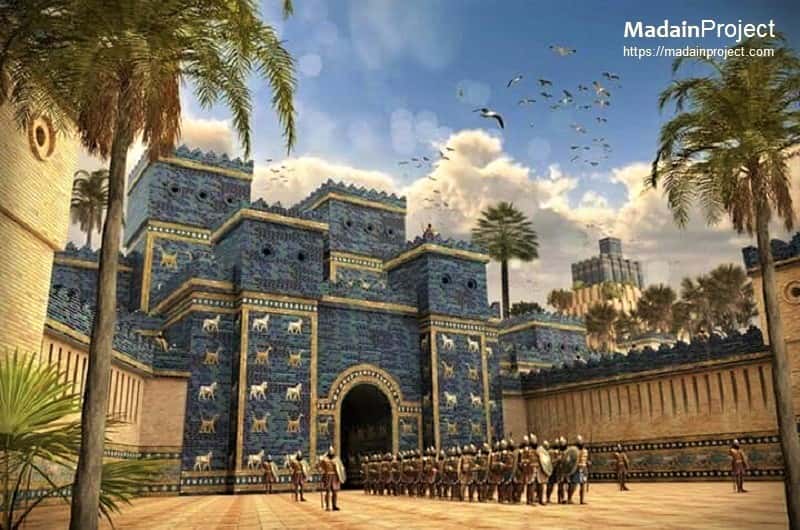
circa
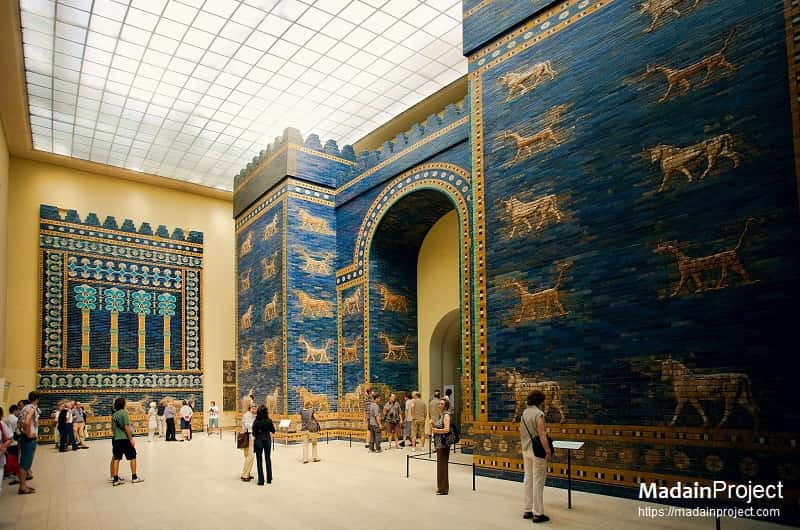
Ishtar Gate
The Ishtar gate was the preeminent monumental entrance integrated into the northern inner fortification wall of ancient Babylon's eastern sector. It was dedicated to Ishtar, the Mesopotamian goddess of love, beauty, fertility, and warfare. Structurally, the gateway functioned as the primary entrance to the city's administrative and palatial core, directly connecting the northern outer approaches to the Processional Way (Ay-ibur-shapu), which led to the Esagila temple complex dedicated to the supreme god Marduk.
Historical documentation for the Ishtar Gate is preserved in Line 49 of Tablet V of the Tintir = Babylon cuneiform series. The gate is listed with its formal ceremonial Akkadian name: Ištar-sāpikat-tebîšu, which translates in academic scholarship to "Ishtar overthrows its assailant" or "Ishtar, the overthrower of her attacker".
The architectural development of the Ishtar Gate occurred in three distinct, sequential construction phases during the reign of King Nebuchadnezzar II, who ruled from 605 BCE to 562 BCE. The initial phase consisted of a regular mudbrick structure adorned with unglazed relief figures. The second phase elevated the road level and saw the gate decorated with unglazed baked bricks. The final, definitive phase was a massive double-gate structure built from vibrant, blue-glazed bricks. The walls of the gatehouse were decorated with alternating tiers of molded relief figures depicting alternating rows of the mušḫuššu (a composite dragon-serpent creature associated with Marduk) and bulls (associated with the storm god Adad). Nebuchadnezzar II commemorated the glazed-brick construction with a detailed cuneiform building inscription embedded directly into the gate’s foundations, detailing the use of cedar beams for the roof and bronze-plated cedar doors.
Enlil Gate
The Enlil Gate, less well-preserved, was aligned with temples devoted to Enlil (ancient Mesopotamian deity of the wind, air, earth, and supreme divine authority), emphasizing the god’s role in Babylonian cosmology and urban order. It was situated on the western flank of the city across the Euphrates river, in the northern wall. Archaeological verification of the Enlil Gate relies extensively on the correlation between early twentieth-century German excavations and the Tintir = Babylon cuneiform tablets (TIN.TIR.KI = Bāb-ili).
The exact textual documentation for the Enlil Gate is preserved in Line 50 of Tablet V of the Tintir = Babylon cuneiform series. It is positioned in the text immediately following the Ishtar Gate (Line 49) and preceding the Marduk Gate (Line 51). In this canonical directory, the gate is cataloged under its formal ceremonial Akkadian name: Enlil-mukin-šarrūtišu, which translates in Near Eastern scholarship to "Enlil Establishes His Kingship" or "Enlil is the one who bestowes him (the king) with success".
Royal Gate or the King's Gate
The Royal Gate or King’s Gate provided access for the monarch and visiting dignitaries, functioning as a secure and symbolic threshold into the western part of the city, situated across the Euphrates. It was built in to the western wall, north of the Adad Gate, of the city's fortification walls.
Structurally, it sat in close alignment with the city's Southern Palace complex (Südburg), which housed the primary throne room and state archives of King Nebuchadnezzar II (605 BCE–562 BCE). This specific placement allowed the royal retinue, foreign dignitaries, and military escorts to enter the bureaucratic core of the empire directly from the southern approaches without routing through the heavily congested civilian and commercial thoroughfares of the central districts.
The precise textual documentation for the King's Gate is preserved in Line 55 of Tablet V of the Tintir = Babylon cuneiform series. It is positioned in the text immediately following the Shamash Gate (Line 54) and preceding the final synthesis lines of the defensive wall catalogue. While its standard topographic label was Abul Šarri ("The King's Gate"), its full ceremonial Akkadian name—Šarru-kēnu-ana-mātika-kūn ("The King is Firm, Establish Your Land" or "May its founder (the king) flourish")—is explicitly written out in the tablet to invoke divine protection over the reigning monarch’s lineage and territory.
Adad Gate
The Adad Gate was associated with the storm god Adad / Hadad, reflecting the military and agricultural significance of divine favor. The gate was one of the two gates built in to the western wall of the western section of the city. It was located south of the "King's gate". Architecturally, the Adad Gate reached its definitive form during the Neo-Babylonian building boom under King Nebuchadnezzar II, who ruled from 605 BCE to 562 BCE. Like the other seven major gates of the inner city wall, the Adad Gate was integrated into a sophisticated defensive system featuring a massive double-wall framework. Built predominantly out of heavy mudbrick and reinforced with bitumen mortar, these structures were designed to withstand both military siege and seasonal weathering.
Physical evidence of the Adad Gate is constrained by the taphonomic conditions of the Babylon site, where centuries of brick-robbing and moisture damage from the fluctuating Euphrates water table have degraded the western fortifications. Scholarly consensus regarding its precise operation relies heavily on the Tintir = Babylon tablets, a series of ancient topographical texts that meticulously catalog the city's sacred geography, walls, and gates. These cuneiform records verify that the Adad Gate stood as a functional counterpart to the eastern gates, completing the defensive circuit that defined Babylon's imperial identity during the first millennium BCE.
Shamash Gate
The Shamash Gate honored the sun god Shamash, whose association with justice was symbolically important for regulating civic life. Cuneiform records and topographic surveys locate the Shamash Gate in the southern inner wall of the city’s western sector. Archaeological investigation of the Shamash Gate in Babylon remains limited compared to its famous namesake in the Assyrian capital of Nineveh. In Babylon, the high water table of the Euphrates river basin has historically restricted deep stratigraphic excavations of layers dating prior to the first millennium BCE. Consequently, much of what is verified regarding the structural layout of Babylon's Shamash Gate relies on the synthesis of Neo-Babylonian architectural texts, spatial alignments with corresponding southern temples, and early twentieth-century surface surveys.
Uras Gate
The Uras Gate (gate named after the deity Uraš), the goddess of the city’s protective rituals. It was built near the eastern egde of the Euphrates river, in the southern wall of the city's eastern section. It is not among the best-documented or archaeologically identifiable gates of Babylon, and its knowledge relies primarily on textual evidence rather than securely associated architectural remains. In available sources, it appears as part of a broader system of named gates integrated into the urban fortifications of Babylon. However, surviving inscriptions do not provide a consistent or detailed architectural description of this specific gate. As a result, its precise location within the urban layout of Babylon is not definitively known.
Textual documentation for this gateway is preserved in Tablet V of the Tintir = Babylon cuneiform series. The tablet records its formal ceremonial Akkadian name as Uraš-amāš-nakiri-isappan, which translates in Near Eastern scholarship to "Uraš overwhelms the fold of the enemy" or "Enimity is his abomination". Like the other southern entrances, its physical remains are severely degraded due to historical brick-quarrying and the high water table of the Euphrates, leaving its precise spatial alignment dependent on early twentieth-century German surface surveys and cuneiform topographical itineraries.
Zababa Gate
The Zababa Gate was linked to Zababa, a war deity (who also served as the patron god of the nearby city of ancient Kish), and marked strategic defensive approaches. It was constructed in to the eastern inner wall of the eastern section of ancient Babylon. It was situated near the southern end of the eastern wall.
In Neo-Babylonian military and civic philosophy, naming this entrance after a prominent war god carried immense defensive symbolism; cuneiform text (Tablet V of Tintir = Babylon) document that the formal ceremonial name assigned to the Zababa Gate was "It Hates Its Attacker" or "it reples him who attacks it", explicitly reinforcing its role as a psychological and physical barrier against hostile forces. In this specific tablet, the entry for the Zababa Gate lists its ceremonial Akkadian name as Zababa-zāyir-tēbîšu, which translates directly in academic scholarship to "Zababa Hates His Attacker" (or "Zababa Overthrows Its Assailant").
Historical and archaeological verification of the Zababa Gate relies heavily on surviving first-millennium BCE textual records rather than extensive physical remains. Because the eastern fortifications of Babylon suffered heavily over the centuries from brick-robbing and high water table saturation from the adjacent Euphrates basin, the physical superstructure has largely disintegrated. However, its precise placement, role, and ritual significance are firmly established within Near Eastern studies through the Tintir = Babylon cuneiform tablets, which systematically map out the imperial capital's sacred topography and list the Zababa Gate as one of the eight canonical inner city entrances.
Marduk Gate
The Marduk Gate celebrated Marduk, Babylon’s patron deity, reinforcing the city’s spiritual and political centrality in Mesopotamia. It was a major gate and was situated in the middle of the eastern wall.
The historical documentation of the Marduk Gate is verified by Line 51 of Tablet V of the Tintir = Babylon cuneiform texts. Where the gate is listed with its formal ceremonial Akkadian name: Šuʾâšu-rēʾî, which translates in academic scholarship to "He is its Shepherd" or "He shows mercy to his friend" (referring to the god Marduk's protective guidance over the citizenry). Textual records like the Tintir series and subsequent spatial mapping by Near Eastern archaeologists establish that the gate served as the western boundary of the Kullab district within the city layout.
Signup for our monthly newsletter / online magazine.
No spam, we promise.

The Madain Project is an online archive of Abrahamic History and Archaeology.
Abrahamic History & Archaeology is the study of history and archaeology with respect to the three Abrahamic Faiths without considering the religious and theological aspects. The goal of Abrahamic History is to understand how and why the religious doctrines and behaviours have evlovled and changed over time. Searching for patterns in the evolution of significant cultural events such as the development of farming, the emergence of cities, or the collapse of major civilizations for clues of why and how these have influenced the three major Abrahamic religions.
Cloud Drive -
About -
Help -
Editorial Policy -
AI Policy -
Privacy Policy -
Contact
Madain Project: Encyclopedia of Abrahamic History & Archaeology.
Copyright MadainProject 2017 - 2026.


