
Naxos (Νάξος)is a Greek island belonging to the Cyclades island group. It is the largest island in the group. It was an important centre during the Bronze Age Cycladic Culture and in the Ancient Greek Archaic Period.
Naxos, the largest and most centrally located island within the Cycladic archipelago, serves as a preeminent archaeological and geological locus for understanding the evolution of Aegean civilization from the Late Neolithic period through the Venetian period and Ottoman era.
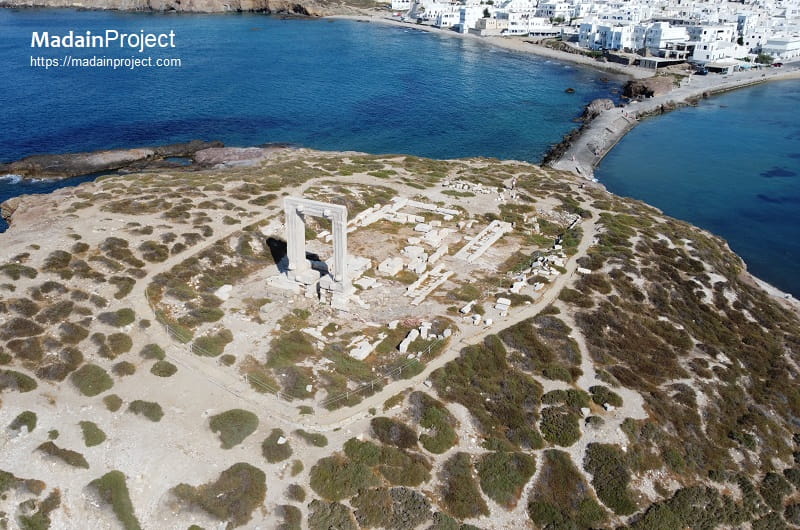
Geomorphologically characterized by its rugged granodiorite and marble-bearing metamorphic core, the island is dominated by Mount Zas (1,004 metres), which provides a unique high-altitude stratigraphic record of human occupation and cultic activity. During the Archaic period / Archaic Greece (7th–6th centuries BCE), Naxos achieved regional hegemony as a center for monumental architecture and sculpture, pioneering the use of large-scale marble extraction and the development of the Ionic order, as evidenced by the iconic Portara on the islet of Palatia and the telesterion at Sangri.
The island’s economic prosperity, historically rooted in its fertile alluvial plains and advanced viticulture, facilitated a complex socio-political landscape that later became the seat of the Duchy of the Archipelago following the Fourth Crusade. This medieval layer is preserved in the distinctive Kastro fortification of Naxos Chora and the numerous fortified tower-houses (pyrgoi) that punctuate the interior.
During the modern period, Naxos remains a critical site for the study of sacred continuity, where prehistoric sanctuaries, Classical period temples, and Byzantine basilicas intersect, reflecting the enduring significance of the island as a crossroads of Mediterranean maritime trade and cultural exchange.
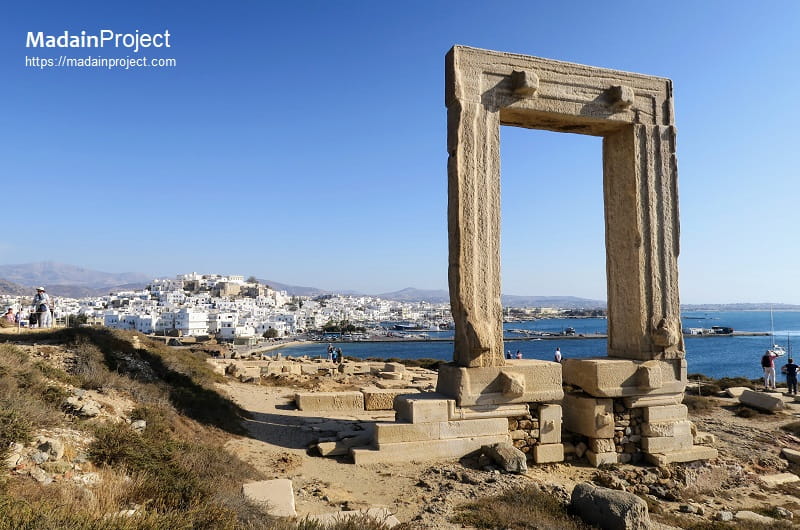
circa
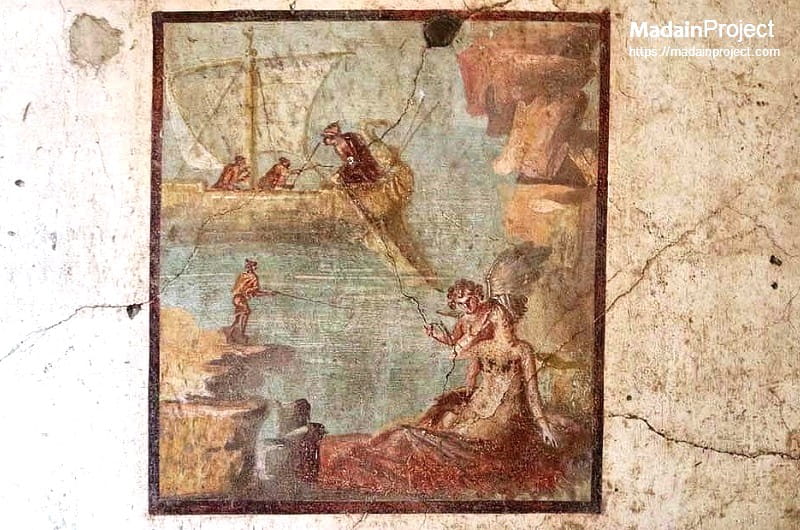
In ancient Greek mythology, Naxos served as a pivotal location for the developmental narratives of both Zeus and Dionysus, establishing it as a primary site of cult worship. While born on island of Crete, Zeus was purportedly raised in a cave on Mount Zas (the highest peak in the Cyclades) to remain hidden from his father, Cronus. Local tradition, recorded by the Naxian historian Aglaosthenis, asserts that Zeus received his thunderbolt within this cave, a symbol of the divine power that eventually allowed him to overthrow the Titans and secure his reign on Mount Olympus. Inscriptions dating to the 4th century BCE further identify the site as a sanctuary for Zeus Melosios, the protector of sheep, reflecting the island's long-standing pastoral religious traditions.
The island’s identity is most inextricably linked to Dionysus, who was often characterized as its patron deity. According to mythological accounts, Dionysus was brought to Naxos as an infant—either following his unconventional birth from Zeus’s thigh or to be raised by the nymphs of Mount Drios (modern-day Koronos). Naxos is also the setting for the celebrated encounter between Dionysus and the Cretan princess Ariadne, who was abandoned there by the hero Theseus after their flight from the Labyrinth of Crete. This is one of the most enduring subjects in classical art, particularly in the Roman frescoes of Pompeii. These artworks typically capture the moment of betrayal as Theseus sails away while Ariadne sleeps or the subsequent arrival of the god Dionysus (Bacchus) to rescue her, as seen in the House of the Vettii. Their subsequent union was commemorated through two distinct annual festivals on the island: a spring celebration of their marriage and an autumn period of mourning for Ariadne’s death. These myths likely functioned as a theological framework for the island's renowned viticulture and its early prominence in the development of monumental Greek temple architecture.
circa

Naxos has a remarkably long and layered history, beginning as early as 200,000 years ago when Neanderthals inhabited the area, as evidenced by stone tools found at Stelida. In prehistoric times, the island also hosted unique wildlife like dwarf elephants. Continuous human settlement followed from the Neolithic period, and by the Early Cycladic era (3200–2000 BCE), Naxos had become an important cultural and economic center, known for its high-quality marble and participation in Aegean trade networks. During the Bronze Age, it fell under the influence of the Minoan and later Mycenaean civilizations. After a brief decline following the collapse of Mycenaean power, Naxos re-emerged as a prosperous force in the Geometric and Archaic periods, playing a key role in Greek colonization and developing strong artistic and architectural traditions.
In the Classical period, Naxos was wealthy but became entangled in conflicts with Persia and later dominated by Athens as part of the Delian League. Control of the island shifted repeatedly in the Hellenistic era and then passed to Rome, followed by the Byzantine Empire, during which it faced invasions and economic decline but retained cultural continuity. After the Fourth Crusade, Venetian rule transformed its political and social systems, leading to the establishment of the Duchy of the Archipelago with Naxos as its center. The island later fell under Ottoman control in the 16th century CE, maintaining local traditions despite imperial rule. Naxos joined the Greek War of Independence in 1821 CE and became part of modern Greece, remaining largely agricultural until tourism and infrastructure development reshaped its economy in the 20th century CE.
circa 4000-370 BCE
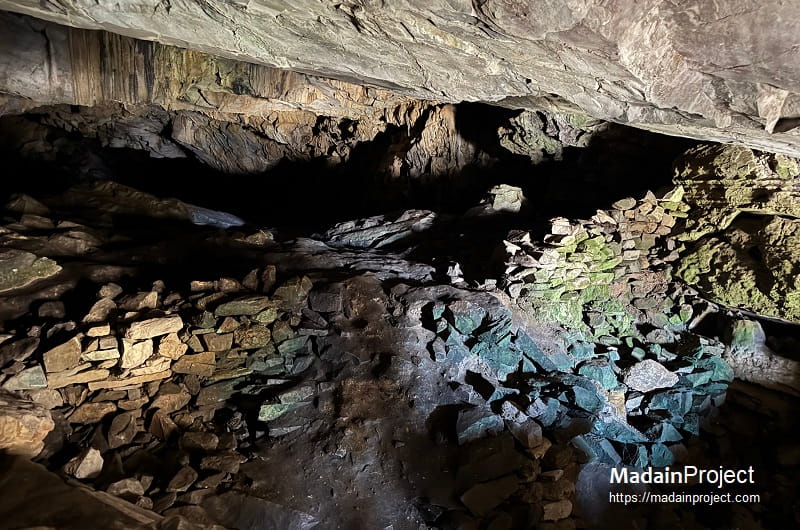
Cave of Zeus
The so-called cave of Zas (Zeus), situated on the western slope of Mount Zas at an approximate altitude of 600–630 metres, represents a critical archaeological sequence for the study of Aegean prehistory. Systematic excavations conducted between 1985 and 1994 CE revealed that the cave was intermittently occupied from the Late Neolithic through the Early Cycladic III periods. Material evidence, including over 300 lithic artifacts, obsidian tools, and ceramics, suggests the site functioned as a multi-purpose space—serving as a seasonal refuge for pastoral activities and a site for complex socio-religious rituals. Of particular significance is the discovery of a small gold plate, potentially linked to the Varna culture of Bulgaria, which provides empirical evidence of early trans-Aegean exchange networks and localized metal processing during the Neolithic era.
Beyond its prehistoric utility, the cave’s stratigraphic record includes artifacts from the Archaic, Classical, and Roman periods, underscoring its enduring status as a "sacred site". While mythological tradition identifies the cavern as the rearing place of Zeus, epigraphic evidence found near the entrance—specifically the inscription "Zeus Melosios" (Zeus as protector of sheep)—confirms its functional role in the cultic landscape of Naxos. The cave's internal morphology, consisting of a substantial primary chamber approximately 115 metres in length, features significant speleothem formations such as stalactites and stalagmites, which likely contributed to its interpretation as a "natural cathedral" and its subsequent use as a Christian chapel and refuge during the Ottoman and Venetian eras.
circa 800-500 BCE
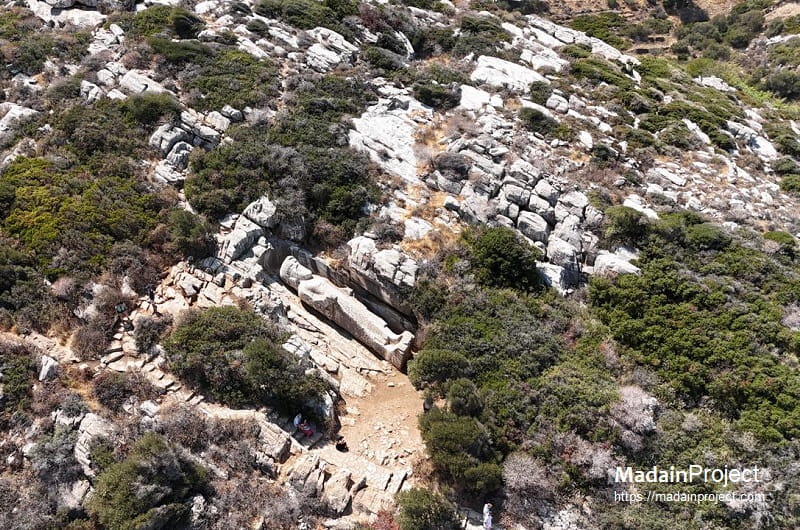
Archaic Quarry
The archaic quarries of Naxos, particularly those located at Flerio (Melanes) and Apollonas, represent some of the most significant industrial landscapes of the Cycladic Seventh and Sixth Centuries BCE. These sites provide critical empirical evidence for the transition from small-scale masonry to monumental marble sculpture. Geologically, the quarries are situated within the island’s extensive marble-bearing metamorphic belt, yielding a coarse-grained, high-quality white marble that became the primary medium for the burgeoning Archaic kouros tradition. The presence of unfinished colossal statues, or kouroi, directly within the extraction pits indicates that primary carving occurred in situ to reduce weight and mitigate the risk of structural failure during the perilous transport process down specialized slipways (holkoi).
The socio-economic implications of these quarries are profound, as they suggest a highly organized labor force and sophisticated mechanical knowledge predating the widespread use of the crane. The Kouros of Apollonas, an abandoned 10.7-meter figure dating to approximately 570 BCE, serves as a primary case study for the technical limitations of Archaic engineering; its abandonment—likely due to the discovery of internal fissures in the stone—illustrates the high stakes of monumental extraction. Furthermore, the proximity of the Flerio quarry to the Sanctuary of Otas and Apollon, where a 6th-century BCE temple was dedicated to the patrons of the quarrymen, underscores the intersection of industrial activity and religious life, reinforcing Naxos's role as the preeminent center of marble craftsmanship in the early Mediterranean.
circa 575-550 BCE
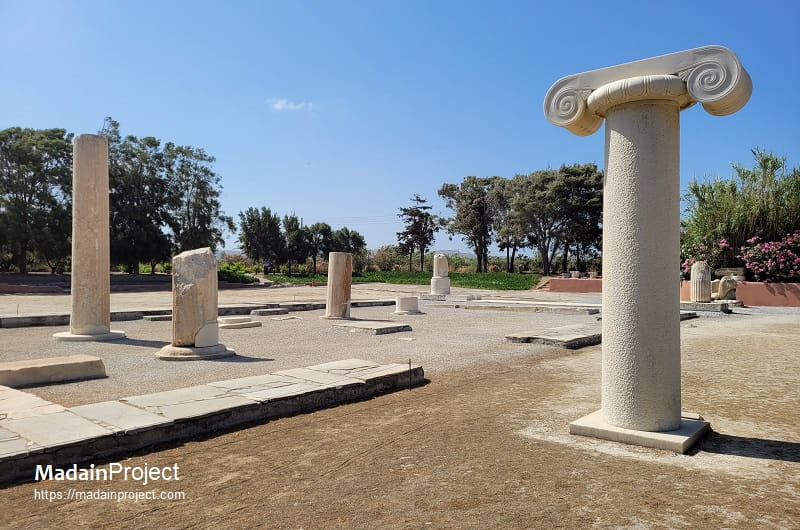
Sanctuary of Dionysus
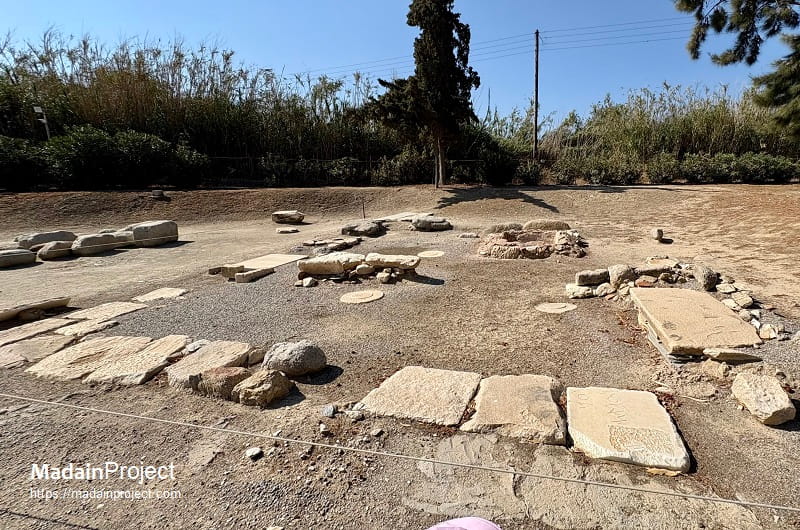
The sanctuary of Dionysus at Iria, situated approximately three kilometres south of Naxos Chora (moden Naxos city), serves as a quintessential archaeological case study for the evolution of monumental Greek temple architecture. Systematic excavations conducted by the University of Athens and the Technical University of Munich between 1982 and 1996 CE revealed a continuous stratigraphic sequence of cultic activity spanning from the Late Helladic III period (circa 1300 BCE) to the Roman era. The site is uniquely significant for documenting four successive architectural phases on the same foundations, transitioning from an open-air enclosure to a sophisticated prostyle tetrastyle marble temple by the mid-6th century BCE. This progression provides empirical evidence for the "birth" of the Ionian architectural order and the experimental use of marble roofing and colonnades that predated the more famous Athenian structures.
The sanctuary’s identification with Dionysus is supported by both epigraphic finds and the site’s specific environmental context within the fertile Livadi plain, an area historically associated with viticulture. Archaeological evidence, including a high concentration of drinking vessels (skyphoi) and ritual dining remains, corroborates the site's function as a center for communal banqueting and Dionysiac worship. During the Archaic period / Archaic Greece, the sanctuary evolved into a pan-Cycladic religious hub, where the monumentalization of the temple reflected the rising socio-political prestige of the Naxian state. The discovery of a Hestiatorion (inspect), a ritual dining hall, adjacent to the main temple underscores the integration of ritualized consumption into the architectural program of the temenos.
From a structural perspective, the fourth and final temple (circa 580–570 BCE) represents a pivotal moment in archaic engineering, featuring an early iteration of a marble peripteral design and a sophisticated drainage system necessitated by the site’s high water table. The reuse of the site in the 5th century CE as a Christian basilica further illustrates the phenomenon of "sacred continuity", where the pagan architectural footprint was adapted to new liturgical requirements while preserving the site’s status as a local focal point. Today, the partial reconstruction of the adyton and the display of onsite architectural members provide critical data for the reconstruction of early Cycladic marble-working techniques and the stylistic development of the Ionic capital.
circa 530-520 BCE
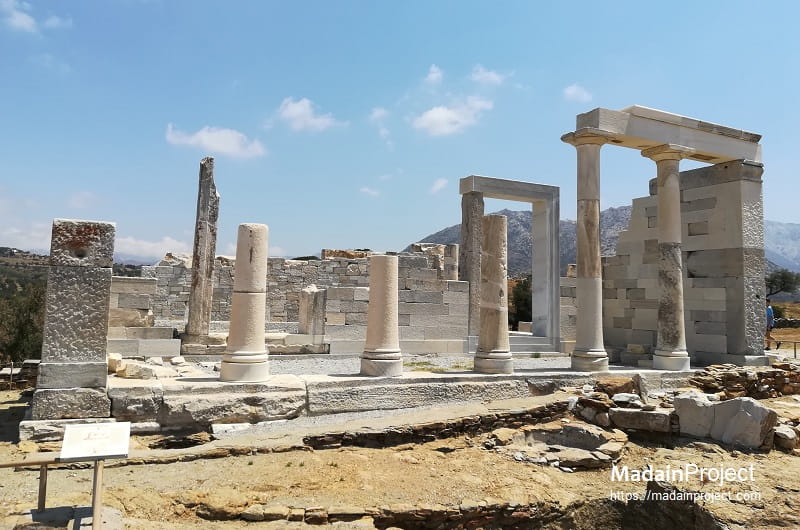
Temple of Demeter
The temple of Demeter, constructed approximately between 530 and 520 BCE during the tyranny of Lygdamis, represents a seminal milestone in the evolution of Ionic architecture. This sanctuary is a rare and exceptionally preserved example of a telesterion—a hall designed for communal initiation and mystery rites—rather than a traditional temple housing a central cult statue. Architecturally, the structure is distinguished by its square ground plan and its innovative use of a double internal colonnade of five columns each, which supported a monumental marble roof. This design allowed for a spacious interior necessitated by the performative nature of the cult of Demeter and Persephone, who were venerated here as the primary deities of agriculture and terrestrial fertility.
The site provides unparalleled empirical evidence for the early mastery of Naxian marble in monumental construction. Unlike contemporary temples that utilized wood or terracotta for upper elements, the Temple of Demeter was constructed almost entirely of local white marble, including its roof tiles and the unique Ionic capitals that lack the traditional volutes, featuring instead a simplified, smooth profile. Systematic excavations and the subsequent anastylosis (reconstruction using original materials and architectural elements) led by Professor Vassilis Lambrinoudakis have revealed that the temple’s architecture intentionally integrated optical refinements, such as a subtle curvature of the stylobate, predating the sophisticated calculations found in the Athenian Parthenon by nearly a century.
Following the decline of paganism, the sanctuary underwent a significant functional transformation in the 6th century CE, when it was converted into a three-aisled Christian basilica. This adaptation involved the partial dismantling of the pagan cella and the incorporation of ancient spolia into the new liturgical structure, a common practice of "sacred continuity" in the Cyclades. The discovery of a baptistery and an adjacent workshop area for olive oil production indicates that the site remained a central hub for the local rural community well into the Byzantine period. Today, the site stands as a critical archaeological reference for understanding the intersection of Archaic engineering, agrarian religious practice, and the transition from polytheism to Christianity.
circa 530 BCE
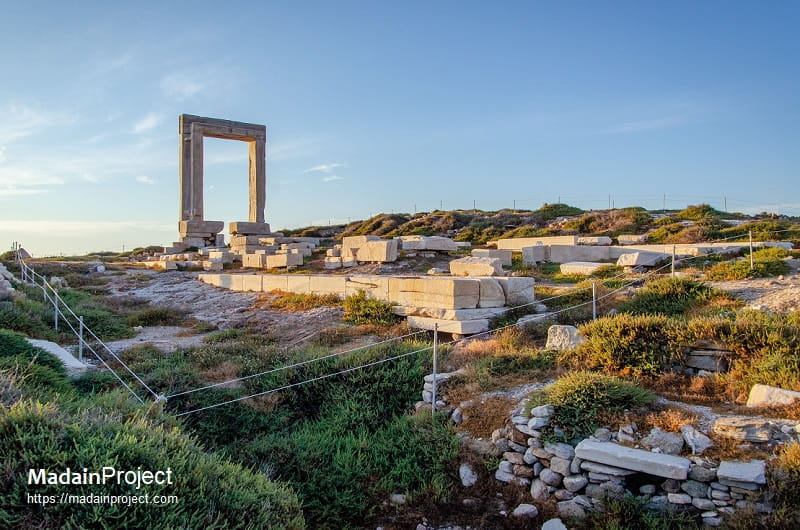
Temple of Apollo
The temple of Apollo, situated on the islet of Palatia at the northern periphery of Naxos harbor, serves as a paramount exemplar of the ambitious monumentalization characteristic of the Archaic period under the tyranny of Lygdamis (circa 530 BCE). Although construction ceased abruptly following the tyrant's deposition in 524 BCE, the extant foundations and the iconic Portara—an 80-ton marble gate—reveal an intended design of a colossal Ionic peripteral temple of the hexastyle-distyle type, measuring approximately 59 by 28 metres.
Architecturally, the temple was designed to face the sacred island of Delos, aligning its cultic orientation with the pan-Hellenic sanctuary of its patron deity, Apollo. The structure is geologically significant for its exclusive use of Naxian macro-crystalline marble, featuring monolithic door jambs and lintels that reflect a level of engineering sophistication and logistical mobilization unparalleled in the mid-6th century BCE. Over subsequent centuries, the site underwent significant functional transformation; during the 5th and 6th centuries CE, the ancient cella was repurposed as a Christian basilica, a transition evidenced by the modification of the internal colonnades and the introduction of a new liturgical axis.
Despite the systematic dismantling of its walls by Venetian authorities in the 13th century CE for the construction of the Kastro, the Portara remained in situ due to the prohibitive mass of its individual components, ultimately surviving as a skeletal diagnostic marker for the architectural transition from late-Archaic experimentation to the standardized Ionic order of the Classical era.
circa 2000 CE
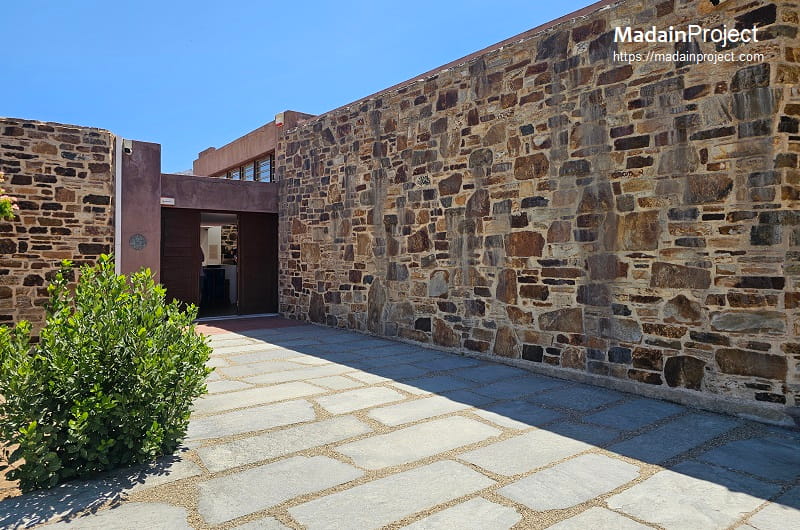
Gyroula Museum
The Gyroula Museum, situated in situ at the archaeological site of the Temple of Demeter near Sangri, functions as a specialized auxiliary repository and interpretative center specifically designed to house the fragmentary architectural members and votive offerings recovered during the systematic excavations of the late 20th century. Architecturally integrated into the surrounding landscape to minimize visual impact on the sacred precinct, the museum's collection is critically significant for its comprehensive assembly of Archaic Ionic elements, including rare marble roof tiles, monolithic columns, and unique smooth-faced capitals that characterize the transition of Naxian marble-working from early experimentation to standardized monumental forms.
The exhibition follows a rigorous stratigraphic logic, displaying the diachronic evolution of the site from its 6th-century BCE floruit as a Telesterion to its 6th-century CE conversion into a three-aisled Christian basilica; notably, it preserves the sculptural remnants of the Paleochristian baptistery and the liturgical spolia incorporated into the later church. By presenting the reconstructed pediments and internal architectural layouts alongside the original site foundations, the Gyroula Museum serves as a vital pedagogical tool for the study of anastylosis techniques and the socio-economic role of agrarian cults in the ancient Cycladic administrative landscape.
circa 600-500 BCE
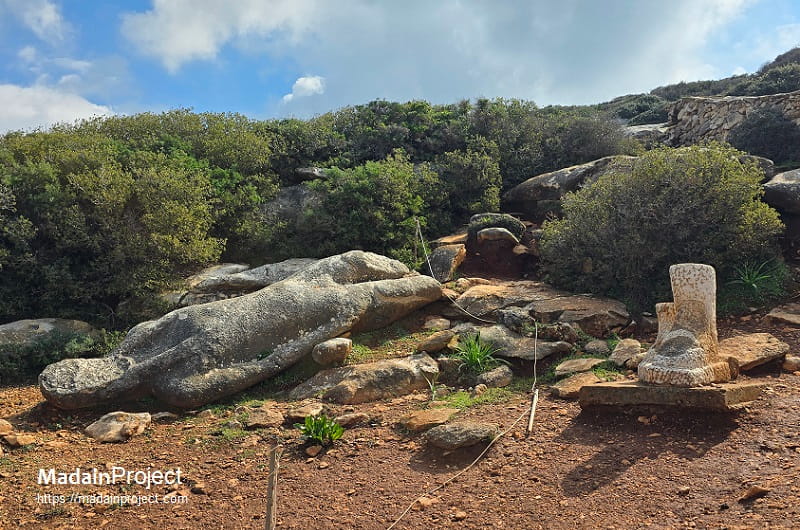
Kouroi of Naxos
The Kouroi of Naxos, located primarily at the ancient quarries of Flerio (Melanes) and Apollonas, represent the vanguard of monumental Greek sculpture and provide critical empirical evidence for the transition from small-scale votive figures to colossal marble statuary during the 7th and 6th centuries BCE. These unfinished, semi-carved figures, such as the 10.7-metre Kouros of Apollonas and the two 5.5-metre figures at Flerio, were abandoned in situ due to the appearance of structural fissures or tectonic fractures in the coarse-grained Naxian marble during the initial extraction phase.
From a technical perspective, these "reclining giants" reveal the sophisticated quarrying methodology of the Archaic Greece, where sculptors performed primary shaping on-site to minimize transport weight before moving the monoliths via specialized slipways (holkoi). Stylistically, the Naxian kouroi exhibit the quintessential daedalic and early Ionic traits—including the characteristic rigid frontal pose and stylized hair—that defined the Naxian school of sculpture, which was instrumental in the architectural and artistic development of pan-Hellenic sanctuaries such as Delos and Delphi.
Signup for our monthly newsletter / online magazine.
No spam, we promise.

The Madain Project is an online archive of Abrahamic History and Archaeology.
Abrahamic History & Archaeology is the study of history and archaeology with respect to the three Abrahamic Faiths without considering the religious and theological aspects. The goal of Abrahamic History is to understand how and why the religious doctrines and behaviours have evlovled and changed over time. Searching for patterns in the evolution of significant cultural events such as the development of farming, the emergence of cities, or the collapse of major civilizations for clues of why and how these have influenced the three major Abrahamic religions.
Cloud Drive -
About -
Help -
Editorial Policy -
AI Policy -
Privacy Policy -
Contact
Madain Project: Encyclopedia of Abrahamic History & Archaeology.
Copyright MadainProject 2017 - 2026.


